
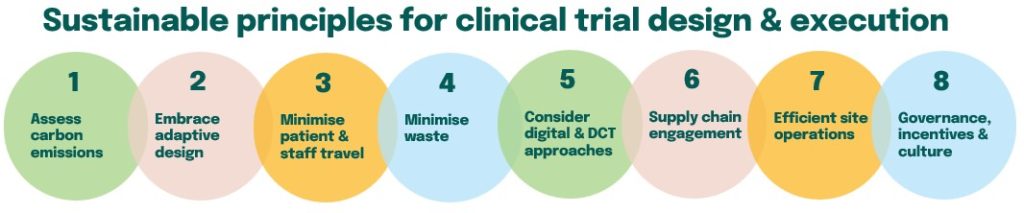
Minimise patient & staff travel in clinical trials
Every visit a trial requires is also a journey with a carbon cost
Redesigning where and how those journeys happen is one of the most direct levers a trial has for decarbonising.
GUIDE | July 2026
Why travel is a lever worth pulling
In a typical multi-visit trial, travel, patients and caregivers commuting to site, site staff commuting to work, nurses driving between homes, monitors flying between sites, couriers moving samples and drug, recurs far more often than almost any other trial activity.
As it repeats at every visit and every site, small changes to how it’s designed compound across the life of the study.
Understand the impact
Below are some decarbonisation strategies to reduce patient and staff travel for consideration. None of the strategies below are easy wins. Reducing travel usually means shifting who does the travelling, how often, or replacing a physical visit with something else entirely, and each of those shifts touches patient experience, data quality, equity of access, or cost.
What to weigh alongside carbon:
- DATA Does the change affect the quality or consistency of what’s measured?
- SAFETY Does the visit exist partly to catch problems a screen can’t?
- EQUITY Does it help or hinder patients without transport, broadband, or flexible time?
- EXPERIENCE Do patients in this indication value face-to-face contact with the investigator?
- NET EFFECT Does it remove a trip, or just relocate it to someone else?
The aim isn’t to eliminate travel, but to be deliberate about which trips are worth keeping.
Telemedicine and virtual visits
Replace patient visits that don’t require a physical exam or procedure with a video or phone consultation.
Co-benefits ~ Cuts a full return trip for the patient and any accompanying caregiver. Widens the eligible patient pool beyond commuting distance, which can improve recruitment reach and diversity. Frees site time and space for the visits that do need a procedure.
Trade-offs ~Not viable where the protocol needs vitals, a physical exam, or in-person safety monitoring. Depending on the indication, oncology, psychiatric care, paediatrics patients may value seeing the investigator in person, and some will request a site visit anyway. Requires reliable broadband and a device, which can quietly skew who enrols.
Fewer, bundled visits
Design the patient visit schedule so assessments are grouped into combined visits where possible rather than scattered across separate ones.
Co-benefits ~ Cuts total trips for patients and staff without removing a single assessment. Usually lowers cost and patient burden alongside travel, and can be applied retroactively to a draft protocol at little risk.
Trade-offs ~ Longer combined visits can be more tiring for frail or paediatric patients, which may hurt retention even as trip count falls. Tighter scheduling windows leave less room to reschedule. Some assessments require timed separation, pre/post-dose PK sampling, for example, which limits how much bundling is possible.
Home health and mobile nursing visits
A qualified nurse or phlebotomist travels to the patient’s home for blood draws, dosing, or vitals instead of the patient travelling to site.
Co-benefits ~ Removes travel entirely for that visit from the patient’s side. Especially valuable for frail, elderly, or mobility-limited participants, and can meaningfully improve retention over a long trial.
Trade-offs ~Swaps one patient trip for nurse visit which could have a positive, neutral or negative net carbon effect. Nurses need trial-specific training, adding cost and inter-visit variability. Some procedures still can’t be done outside a clinical setting.
Mobile trial units and satellite clinics
Bring a mobile unit or temporary satellite clinic to a patient cluster for a batch of visits, instead of each patient travelling individually.
Co-benefits ~ Converts many individual patient trips into a single staff trip. Especially effective for rural or underserved regions with a cluster of eligible patients, a strong equity co-benefit alongside the carbon saving.
Trade-offs ~ The unit itself has to travel, fuel, staging, equipment transport, and its schedule may not align with when an individual patient needs care. Limited to procedures that fit a mobile setting, and carries higher upfront logistics cost than a fixed site.
Site selection close to the patient population
Select trial sites based on where eligible patients actually live, and that are well connected by public transport or near major medical centres reduce travel-related emissions for participants, investigators, and monitors.
Co-benefits ~ Shortens the average round trip for the whole trial duration, not just one visit. Can speed enrolment and improve diversity by reaching underserved communities, a one-time decision with a compounding effect across every later visit.
Trade-offs ~Newer or community sites may have less trial experience, raising training and data-quality risk. Spreading enrolment across more, smaller sites can increase staff travel for training and monitoring. Specialist procedures may still only be available at a handful of centres regardless of geography.
Virtual or regional investigator meetings
Run the investigator kick-off meeting, and ongoing site-staff training, remotely instead of flying investigators and coordinators from every site to one venue or host regional meetings.
Co-benefits ~ Removes the single largest per-person trip many site staff take in a trial, since investigator meetings often draw people internationally to one city. Cheaper and faster to schedule, and easier to record and re-share for staff who join a site mid-study.
Trade-offs ~The in-person meeting is also where sponsor teams build relationships with investigators and read the room on protocol concerns, harder to replicate over video, especially for a first-in-class or complex protocol. Hands-on training (device use, sample handling) may still need an in-person or hybrid session. Engagement and retention of training content can drop in a long virtual session.
Risk-based and remote monitoring
Reduce clinical research associate site visits by monitoring more data remotely, reserving on-site checks for higher-risk sites or findings.
Co-benefits ~ Cuts one of the largest sources of staff travel, since monitors often fly between many sites in a study. Frees monitor time for the sites that genuinely need hands-on support, and scales well across large multi-site trials.
Trade-offs ~Depends on clean, timely electronic source data, sites with weak systems may end up needing more visits, not fewer. Some issues, like drug accountability or facility conditions, are hard to catch remotely. A miscalibrated risk model can leave smaller or newer sites under-monitored
Update staff travel policy to promote virtual first and green travel
Make virtual meetings the default for internal sponsor and CRO activity, team meetings, site check-ins, audits where feasible, and pair it with incentives for lower-carbon travel modes when travel is genuinely necessary.
Co-benefits ~ A written “virtual by default” policy removes the awkwardness of individual staff having to justify skipping a trip. Incentives for rail over short-haul flights, or trip-bundling for staff visiting multiple sites in a region, cut emissions on the travel that remains and can lower cost too.
Trade-offs ~ Rigid rules invite exceptions that erode the policy’s credibility. Green travel incentives (rail, off-peak, bundled routing) can mean longer journey times, which has a real cost in staff time and wellbeing. Savings depend entirely on consistent uptake, so the policy needs monitoring and buy-in, not just publication


