
How to do a care pathway assessment with the SHC care pathway calculator
A step-by-step guide
The care pathways approach allows the appraisal the entire patient journey, identifying areas where the environmental impact of that care pathway can be reduced without compromising patient safety and experience. The SHC method sets out how to undertake a care pathway assessment using life cycle assessment (LCA), and can be applied at different levels of depth and data quality depending on your objectives and resources – from a high-level estimate through to a full, primary-data-led LCA study.
If you would like to produce a high-level estimate, we suggest using the care pathways carbon calculator: this is free to access and has been deliberately kept simple and entry-level, drawing on secondary data and higher materiality thresholds, so it should be treated as an indicative estimate rather than a substitute for a more detailed study. The primary metric that the calculator measures is carbon, but the full method also covers freshwater use and waste generation. Other tools are available that support a more detailed application of the SHC method, such as CARESA.
This resource will walk you through how to do a care pathway assessment using the calculator. The process is structured, repeatable, and designed to be done by beginners, not experts.
Before you start
You will need:
- A clear idea of the patient group and condition you are looking at (for example: adults referred for elective cholecystectomy via the outpatient route)
- A description of what happens to a typical patient on that pathway
- A sense of how many patients go through it, or a representative sample to work from
It helps to have:
- Activity data – for example, how many outpatient appointments happen per patient
- Information on how patients travel to appointments and roughly how far
- A colleague who knows the pathway well, if it is not your own
Start with what you know – you can refine the assessment later with better data. A high-level assessment done with approximate numbers is far more useful than no assessment at all.
The building blocks: pathway modules
When you map your pathway, you will group activities into modules. A module is simply a type of clinical contact or activity – a GP appointment, a surgical procedure, a hospital admission. We have pre-calculated a carbon emission factor for each module, which means you do not need to calculate the carbon of individual activities from scratch.
The current modules are:
- GP consultation – a standard primary care appointment
- Emergency department visit – attendance at an A&E department
- Surgical procedure – an elective or emergency operation
- Inpatient bed day – one day as an admitted patient in hospital
- Self-management – activities the patient carries out at home
- Patient travel – journeys a patient makes to receive care
Each module has its own detailed guidance document, including what is included in the carbon calculation and how to apply it.
The six steps
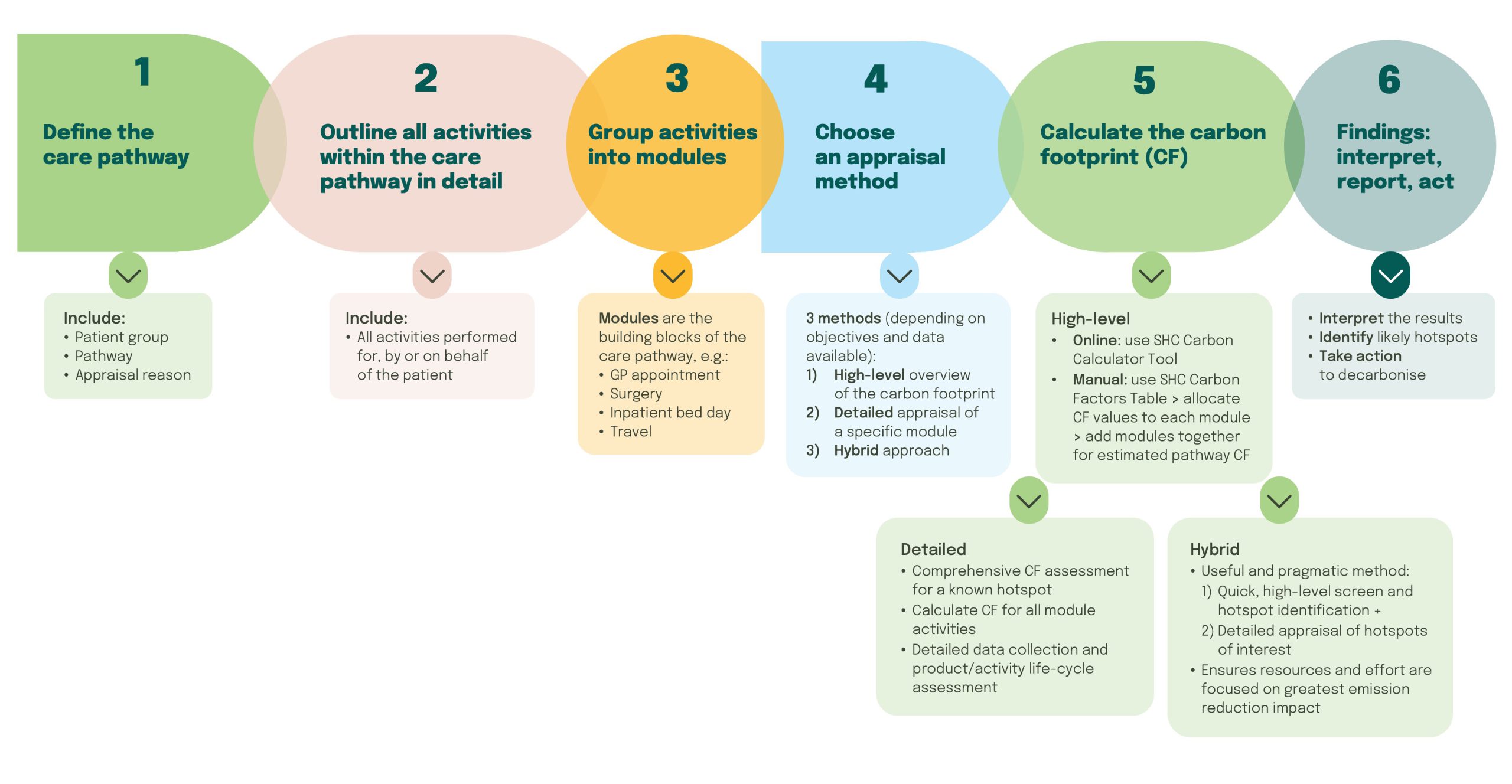
We have broken the process down into six simple steps. The first three focus on mapping the pathway. The second three focus on measuring and interpreting the environmental impact.
Step 1: Define the care pathway
Start by being specific about what you are assessing.
- Who is the patient? What condition do they have?
- What does the pathway cover – from which point to which point?
- Why are you doing this assessment? For example: to identify carbon hotspots, to compare two models of care, or to support a business case for service change.
The clearer your definition, the more useful your results will be.
Example: “Our objective is to assess the adult elective laparoscopic cholecystectomy pathway via the outpatient referral route, using 10 patients as a representative sample. The reason for the appraisal is to identify carbon hotspots and target them for quality improvement.”
Step 2: List every activity on the pathway
Write down everything that happens to a typical patient on this pathway. Include every appointment, test, procedure, admission, and journey. You are building a picture of one patient’s full journey from start to finish. A simple written list is enough – you do not need a formal process map.
Example: For the cholecystectomy pathway, activities included:
- GP appointment for suspected biliary colic (including patient travel)
- Referral for diagnostic tests – ultrasound scan and blood tests
- Follow-up GP appointment
- Specialist surgical outpatient clinic
- Pre-operative assessment clinic
- Elective admission for day-case laparoscopic cholecystectomy
- Follow-up specialist outpatient clinic
Step 3: Group activities into modules
Look at your list and sort each activity into one of the SHC modules. Most clinical activities will map naturally onto one of the six module types. If something does not fit neatly, use the closest match and note the assumption you have made.
Example: For the cholecystectomy pathway, the activities grouped into: GP Consultation (×2), Diagnostic Imaging (×1 ultrasound), Outpatient Clinic (×3, using GP Consultation value as a proxy), Surgical Procedure (×1), and Patient Travel (multiple trips).
Step 4: Choose how you will do the assessment
There are three approaches. Choose based on your purpose and the data you have.
Quick overview
Best for: a first read of the pathway, or making the case for a fuller assessment.
Apply a pre-set carbon value to each module using the SHC carbon calculator or carbon factors table. Add them together. You will get a whole-pathway estimate quickly, with minimal data required.
Detailed appraisal
Best for: a specific module you already know is a significant contributor.
Collect detailed activity and product data for that module and calculate its carbon footprint from first principles. This gives a precise, defensible number but requires more time and data. Typically done by teams with research or audit capacity, or in partnership with SHC.
Hybrid
Best for: a thorough assessment without excessive data demands.
Do a quick overview of the whole pathway first to identify the hotspots, then do a more detailed appraisal targeted at those specific modules. This is the most practical approach for most clinical teams doing a pathway assessment for the first time.
Step 5: Calculate the environmental impact
Apply your chosen approach to calculate the environmental impact of each module, then add them together to get the total pathway footprint. The fastest route is the SHC carbon calculator, which takes your module frequencies as inputs and produces a carbon figure automatically. Alternatively, use the SHC Carbon Factors Table to do the calculation manually.
Worked example: elective laparoscopic cholecystectomy pathway
The table below shows a manual high-level calculation using the SHC Carbon Factors Table.
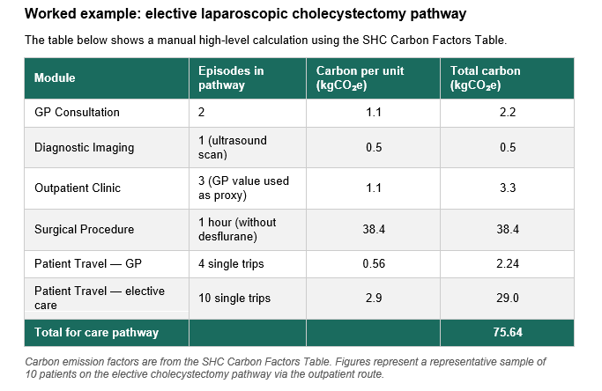
Carbon emission factors are from the SHC Carbon Factors Table. Figures represent a representative sample of 10 patients on the elective cholecystectomy pathway via the outpatient route.
Step 6: Interpret the results and identify your hotspots
Look at the breakdown and ask: where is the carbon concentrated? In most pathways, a small number of activities account for the majority of the footprint. These are your hotspots – the places where changes will make the biggest difference. If you have also collected data on water use or waste, the same hotspot logic applies – look for where the impact is concentrated, and focus your efforts there.
Example: In the cholecystectomy pathway, two clear hotspots emerged: the surgical procedure (38.4 kgCO2e – more than half the total footprint) and patient travel to elective care (29.0 kgCO2e). Together, these two modules account for around 90% of the pathway’s carbon.
- Streamlining pre-operative appointments to reduce the number of separate trips to hospital
- Introducing green theatre practices – low-carbon anaesthesia, reusable equipment, switching off theatre lighting and equipment when not in use
Your results, even from a high-level assessment, are the starting point for a meaningful conversation about sustainable care.
What happens next?
Once you have your results, you can use them to:
- Make the case for change: present your findings to clinical leads, service managers, or your trust sustainability team
- Design a more sustainable pathway: use the hotspot analysis to target changes where they will have the most impact
- Compare models of care: assess the environmental impact of a new or alternative pathway against the current one
- Contribute to the evidence base: SHC is building a library of care pathway assessments across different clinical areas
Taking action on your findings, including specific decarbonisation strategies by clinical setting, is covered in a separate section
Need support?
SHC works directly with clinical teams, NHS organisations, and industry partners to design and deliver care pathway assessments. Whether you need light-touch guidance or hands-on involvement…


