
Assess carbon emissions
Use the Clinical Trials Carbon Calculator to compare scenarios and identify carbon trade-offs quantitatively before finalising protocol decisions. Data-driven design prevents costly environmental mistakes

The most effective place to focus emission-reduction efforts is before a trial even starts: in the design phase. Building environmental considerations into early protocol development embeds sustainability by design, rather than retrofitting it after the protocol is finalised.
GUIDE | Aug 2026
Applying a sustainability lens to protocol development often streamlines trials, reducing unnecessary visits, procedures, and paperwork, which lowers costs and participant burden.
It can improve patient retention and increase access as well as decreasing timelines and strengthening data quality. Sustainable trials support resilience over disruption, and build long-term regulatory and public trust in research.
Explore our resources to find real-world implementation cases of where applying a sustainable lens to protocol design has led to multiple co-benefits including cost avoidance and improved efficiency in trial operations.
Decisions made to reduce carbon emissions can unintentionally shift them elsewhere or even increase the overall footprint. For example, reducing patient travel may increase medication shipping and staff travel.
Decarbonisation strategies should be applied where it measurably reduces patient, site, data and environmental burden, without shifting that burden elsewhere. Always view protocol changes holistically, and remember that patient safety and data integrity come first.
Use the Clinical Trials Carbon Calculator scenario functionality to compare design choices and understand carbon trade-offs before committing to a protocol.
Sustainable trial design rests on a eight principles that should inform every protocol or operational decision from the earliest planning stages.
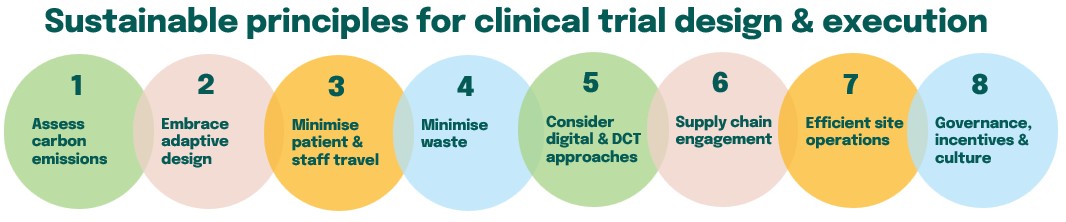
Use the Clinical Trials Carbon Calculator to compare scenarios and identify carbon trade-offs quantitatively before finalising protocol decisions. Data-driven design prevents costly environmental mistakes

Adaptive trial designs allow real-time adjustments based on accumulating data, modifying sample size or treatment arms in response to emerging evidence for faster, more efficient trials

Redesign visits, monitoring, and site logistics so fewer people need to physically move to deliver the same trial
Design out unnecessary consumables, packaging, and oversupply at the protocol and forecasting stage, and divert what remains from disposal.

eConsent, eCOA, telemedicine visits, at-home nursing, direct-to-patient investigational product shipments, and other decentralised trial (DCT) elements may reduce patient travel burdens and site-visit frequency
Streamline the manufacturing, distribution, and cold-chain logistics that move drug and materials to site
Reduce the energy, space, and material footprint of running the sites and facilities a trial depends on
Navigating change can be tough. Embedding new processes into business as usual requires a robust infrastructure of process, training, tools, KPIs and governance to ensure lasting impact
A practical tool for reviewing your trial protocol, section by section, through a sustainability lens covering site selection, study design, IP and lab logistics, devices, travel, and monitoring.
Work through each topic area to identify opportunities to embed environmental considerations into your design while protecting patient safety and study integrity.
Remember that each trial is different and some questions will not be appropriate for your trial.
Caution: Decisions made to reduce carbon emissions can unintentionally shift them elsewhere or even increase the overall footprint. Use the Clinical Trials Carbon Calculator scenario functionality to compare design choices and understand carbon trade-offs before committing to a protocol.


