
Assessing carbon emissions of clinical trials
A structured, repeatable approach to measuring the carbon footprint of clinical trials
This page sets out the Sustainable Healthcare Coalitions clinical trial assessment framework, released in 2024, developed in collaboration with the industry Low Carbon Clinical Trials (iLCCT) consortium. It is designed to be used by anyone – clinicians, planners, and industry teams, at any scale, and with whatever data is available. The methodology underpins the Clinical Trial Carbon Calculator, coalition’s free tool for running your own assessment.
GUIDE | July 2026
The Clinical Trials Carbon Assessment Framework
A framework of guidance and tools that, taken together, form an important reference for stakeholders wanting to both understand and reduce the environmental impact of clinical research.
The Method
The Clinical Trials: Environmental Assessment Method is an essential element of the Clinical Trials Carbon Assessment framework for estimating the environmental footprint of a clinical trial.
It uses a step-wise process to sum carbon from a number of separate activities (modules) associated with design, management and operation to estimate the overall carbon footprint (kgCO2e) of a trial. Such calculations can be used to appraise the relative materiality of different activities and guide users to where greatest opportunity exists for reducing the carbon footprint of clinical research.
It can be applied to clinical trials that have been completed, that are partially complete, or that are in the design and planning stage.
When the method is applied in full, it is in alignment with the International Standard for Life Cycle Assessment (LCA) (ISO14044) and the Greenhouse Gas Protocol, Product Life Cycle Accounting and Reporting Standard.
This Clinical Trial Carbon Calculator has been produced to help provide a rapid and simple means to produce some indicative numbers on carbon emissions associated with trials. It should not be seen as a surrogate for a full assessment in accordance with the Clinical Trials Carbon Assessment Framework.
How to assess a trial
Follow these six steps to assess the carbon footprint of a clinical trial.
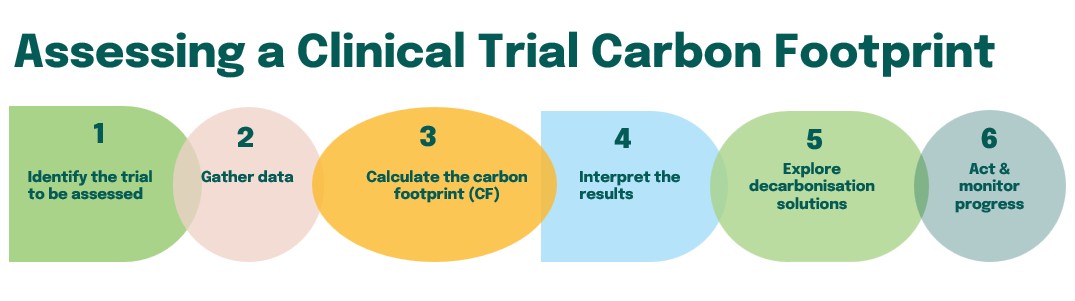
A summary of each step is provided below.
For complete technical guidance including data collection, emission factors, allocation and reporting requirements — refer to the full method document.

1. Identify the trial to be assessed
The calculator can be used before, during, or after a trial, for planning at RFP/protocol stage, for inflight decision-making, or for retrospective analysis. It supports Phase 1–4 trials sponsored and operated in any geography.

2. Gather data
Use the user start guide within the calculator to identify what data you'll need. Collect this information before you begin entering it into the tool. The data needed may come from multiple sources within your organisation.
3. Calculate the carbon footprint
Use the Clinical Trial Carbon Calculator to calculate your footprint. Enter primary data for a detailed appraisal, secondary data for a high-level appraisal, or a mix of both. The more primary data you use, the more accurate your footprint calculation will be.
Clinical Trial Carbon Calculator
4. Interpret the results
The calculator outputs your trial's overall footprint, footprint per participant, and a granular breakdown by subheading and element, showing each one's percentage contribution. Use this to identify carbon hotspots, model potential changes, or learn lessons for future trial design.
5. Explore decarbonisation strategies
Visit the Sustainable Trials by Design page for guiding principles on reducing your trial's impact. Check the resources section for real-world examples of decarbonisation strategies already in use.
Sustainable clinical trials by design
6. Act and monitor progress
Implement your chosen strategies and track their impact over time. Share your findings with the Sustainable Clinical Trials Community of Practice.
Sustainable clinical trials community of practice

